For a useful PCB quote comparison, first confirm that each supplier has priced the same finished board, fabrication requirements, and delivery scope. Identical Gerber layer files can lead to different prices because quotations may use different material, copper, finish, panelization, or inspection assumptions. Once those differences are resolved, a remaining price gap can be evaluated on commercial grounds.
The practical output is an agreed construction and a short list of explicit exceptions. A buyer should be able to identify what will arrive, which requirements it meets, and what remains subject to engineering approval before placing the order.
A lower quotation can describe a different board
Hypothetical example: an OEM requests 500 bare, four-layer PCBs using its released fabrication package. Offer A totals $2,800; Offer B totals $2,400. These invented figures illustrate a purchasing review, not market pricing.
| Released requirement | Offer A | Offer B | Purchasing action |
|---|---|---|---|
| Approved laminate and stackup | Specified construction confirmed | FR-4 with the requested Tg; laminate unspecified | Obtain the proposed construction and engineering disposition |
| Finished outer copper per drawing | Requirement acknowledged | 35 micrometers stated without identifying base or finished copper | Resolve the copper definition and acceptance basis |
| ENIG surface finish | ENIG included | Lead-free HASL proposed | Request the released finish or a separately approved alternative |
| Bare-board electrical test | Included | Excluded from the stated total | Obtain the price for the required test scope |
The apparent $400 difference is unresolved until B is priced against the released requirement. That does not establish that A is the better supplier, or that B produces inferior boards. B may offer a worthwhile alternative construction, but engineering must approve it and purchasing should compare that option separately.
Give every supplier one controlled fabrication package
Gerber data can contain more than layer images. Ucamco's Gerber Job documentation explains that the job file can carry fabrication information such as materials, finish, and overall thickness. Partial implementations are permitted, so check what your CAD export actually supplies rather than assuming those fields are present.
Identify the board part number, revision, and release date on the request. Send the same archive to every bidder, including drill and outline data, layer identification, fabrication drawing, stackup, and applicable requirements. Include a Gerber job file when available. Have engineering resolve contradictions between these inputs before suppliers choose their own interpretation.
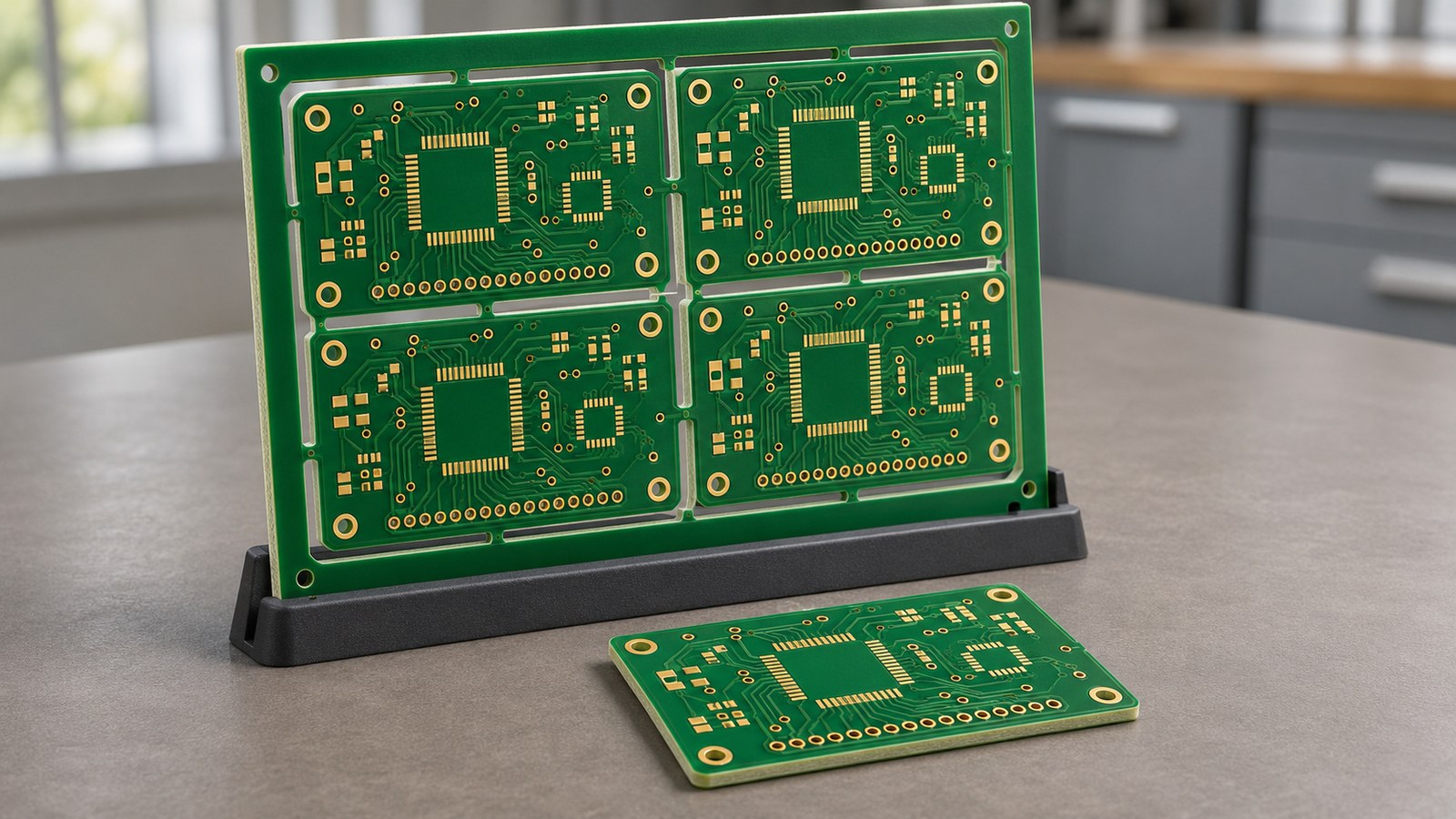
State whether you want individual boards or delivery panels. If a panel is required, define its arrangement, rails, separation method, and relevant assembly constraints. Ask suppliers to distinguish the panel delivered to your assembler from any larger production panel used internally for fabrication.
Request a written exception list. A response that identifies a proposed change is easier to evaluate than a general statement that the supplier can manufacture the files.
Build the PCB quote comparison around construction details
Material and stackup: qualify the offered construction
A material family and glass transition temperature, or Tg, do not fully describe a laminate. Request the proposed manufacturer, material designation, and stackup when your design or customer requirements depend on them. Where a performance-based material specification is permitted, state the approved boundaries and substitution process.
This is a current sourcing concern as well as a design detail. In its 16 October 2026 material-change guidance, NCAB reported tightening standard FR-4 supply as laminate suppliers emphasize AI and high-speed materials. It also explains that apparently similar materials can differ in electrical, thermal, and processing properties, affecting stackup and qualification.
That report does not establish availability for a Cplus enquiry. It supports a practical question: which material has actually been priced? Ask engineering whether a proposed change affects impedance, assembly processing, or customer approvals. Keep an unapproved material option visibly conditional.
Copper: identify the layer and manufacturing stage
“One-ounce copper” is an incomplete comparison if one offer means starting foil and another means the finished conductor. Eurocircuits distinguishes base copper from finished copper: plating adds copper, while cleaning and micro-etching can remove it.
Ask for the quoted inner- and outer-layer copper requirements separately. Record whether each figure is nominal or a required minimum, together with the applicable acceptance basis. A purchasing spreadsheet should preserve those definitions rather than converting every entry into a single “copper weight” column.
Finish, holes, and vias: resolve specific exceptions
Match the finish to the released drawing. If a different finish is proposed, request a separately identified option for engineering and assembly review. Do the same for finished hole sizes, critical outline tolerances, and any specified via filling, plugging, or capping.
A broad phrase such as “via protection included” should lead to a clarification of the actual construction. Ask the supplier to reference the affected feature and drawing requirement. This keeps the quotation review focused on requirements that could change the delivered board.
Agree what inspection and testing will establish
Bare-board electrical testing checks the fabricated interconnections. Eurocircuits describes checking nets for opens and shorts against board data. This has a different purpose from powering and functionally testing an assembled product.
For each offer, confirm whether the required electrical test, impedance measurements where specified, and fabrication inspection are included. Identify the applicable specifications, revisions, acceptance class where required, and requested records. A supplier's general quality statement does not answer which deliverables are included in this quotation.
If the requirement includes populated boards, define that scope separately. Cplus lists PCB assembly among its contract-manufacturing services. A bare-board fabrication price alone does not establish component sourcing, assembly, programming, or functional-test coverage.
Compare the payable amount and the production-release conditions
After construction is aligned, confirm the quantity basis: individual boards, delivery panels, and boards per panel. Separate recurring board charges from tooling, setup, required testing, and documentation. Ask which charges recur on an unchanged repeat order. Keep freight, delivery terms, and applicable taxes or duties visible when comparing the payable amount.
Then identify what starts the quoted manufacturing period. Does it begin after order acceptance, payment, final data review, stackup approval, or resolution of engineering queries? Record transit separately and work back from the receiving date your assembler needs.
Have the final quotation reference the approved package and resolved exceptions. If a manufacturability review proposes changed geometry or construction, retain the engineering approval and updated release before fabrication. Equivalent offers may still differ in price; those are the offers purchasing can meaningfully evaluate for cost, schedule, and supplier suitability.
Prepare a Cplus PCB quotation request that can be compared
The Cplus PCB quotation form provides selections for sales unit, layer count, material/Tg, thickness, inner copper, base outer copper, finished outer copper, and finish. Check those selections against the controlled fabrication requirements. Where a requirement exceeds a dropdown's detail, identify it in the accompanying fabrication documentation and obtain written acknowledgment.
Prepare the enquiry with:
- The board identity and revision, required quantity, and clear individual-board or panel basis.
- The released fabrication package and any approved alternative constructions, identified separately.
- The required inspection, test, and documentation scope.
- The delivery destination and required receiving date, provided with the enquiry documentation.
The form accepts a ZIP file up to 15 MB and requires drill and outline files inside it. Submit the controlled package through that route and request a quotation that identifies the offered construction, exceptions, and included charges. That gives your team a concrete basis for choosing a supplier and releasing the order.