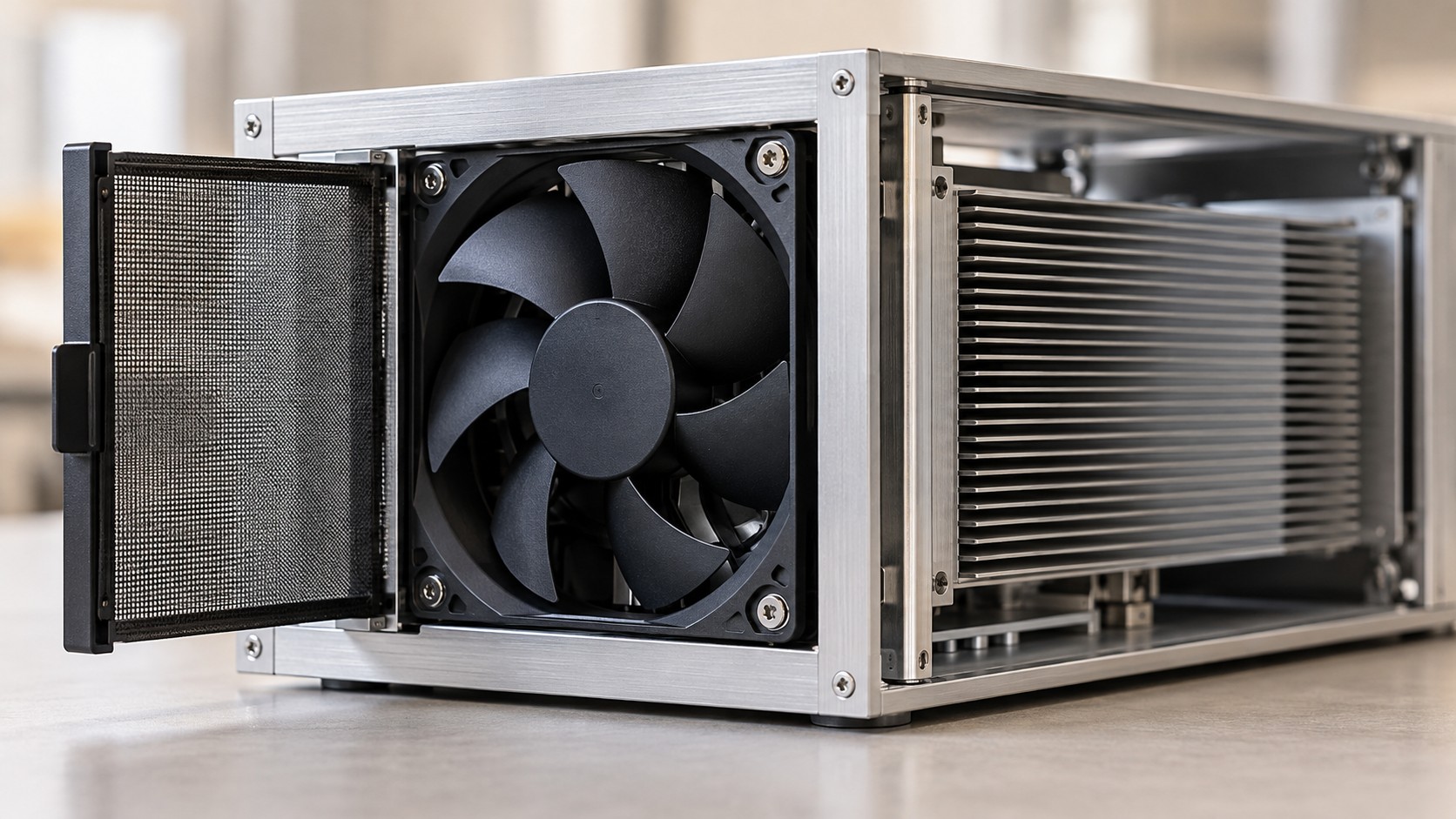
Cooling fan selection should start with the airflow required inside the equipment and the resistance that airflow must overcome. Compare each candidate at that operating condition, then verify its mounting, power supply, speed control, and monitoring signals. A higher maximum CFM rating alone cannot establish that a replacement will cool the equipment adequately.
This matters when an OEM or contract manufacturer needs an alternative fan for a filtered enclosure, power supply, or compact control unit. Two fans can share dimensions and nominal voltage while behaving differently behind a filter or heat sink. Purchasing needs a requirement that preserves the approved cooling duty, with engineering responsible for validating the proposed change.
Define the cooling duty before comparing offers
Ask the equipment designer for the minimum required airflow, the corresponding system pressure loss, and the conditions behind those figures. Include the heat load, inlet-air temperature, permitted temperature rise, enclosure configuration, and commanded fan speed. For an existing design, the approved fan and its qualification records provide a starting point.
The thermal requirement concerns heat dissipated inside the equipment. For example, a power supply's output rating is not automatically the heat that its fan must remove. Also distinguish average air temperature from the temperature limits of individual components; adequate total airflow can coexist with a poorly cooled hot spot.
If airflow or resistance is unknown, record that as an engineering gap. Establish the requirement through suitable analysis and measurement before treating a catalog alternative as approved. Cplus's DC brushless fan catalog can help identify candidates, but the listings do not establish installed cooling performance or current availability.
Airflow vs static pressure: read the whole curve
Airflow is the volume of air moved per unit time, commonly expressed in CFM or cubic metres per hour. Static pressure is commonly expressed in pascals or water-column units. The pressure-flow characteristic, often called the P-Q curve, shows how the two quantities relate for a fan under specified conditions.
Maximum airflow normally describes operation with zero backpressure. Maximum static pressure describes the opposite endpoint, with airflow blocked. Those two maxima are separate conditions; a fan does not deliver both simultaneously. ADDA's explanation of fan characteristics describes these endpoints and the resistance introduced by filters, heat-sink fins, vents, and dense layouts.
The system also has a pressure-loss curve: the pressure required to move different amounts of air through the equipment. Overlay it on the candidate's fan curve. Their intersection identifies the expected operating airflow and pressure. Orion Fans explains this operating-point method and how changes such as filter loading affect the result.
Use the curve for the exact model and intended supply voltage and speed. Normalize units before comparing offers. A curve for another speed variant or a full-speed test does not establish performance at the controller's normal command. Request the complete curve rather than interpolating a straight line between the two catalog maxima.
A worked comparison: the higher-CFM offer falls short
Hypothetical example: a filtered control enclosure requires at least 30 CFM. Its engineering team has established a pressure loss of 80 Pa at that airflow. Two proposed 24 V fans fit the same mounting space. The following figures are invented for illustration and describe no actual product or supplier test.
| Comparison point | Candidate A | Candidate B |
|---|---|---|
| Maximum free-air airflow | 70 CFM | 60 CFM |
| Pressure available at 30 CFM on the assumed fan curve | 60 Pa | 100 Pa |
| Initial engineering assessment | Insufficient at the required duty point | Candidate for further qualification |
At 30 CFM, Candidate A cannot supply the required 80 Pa. Assuming smoothly decreasing fan curves and an increasing system-resistance curve in the relevant region, its intersection falls below the required airflow. Candidate B has pressure capability above the requirement at 30 CFM, so its intersection can fall above that minimum despite its lower free-air rating.
Candidate B still needs a full operating-point review and an installed test. The comparison does not establish acceptable noise, electrical compatibility, temperature margin, or performance as the filter loads. If the 80 Pa requirement describes only a clean filter, repeat the assessment for the agreed service condition before approval.
Check the control and alarm behavior separately
A thermally promising fan may still be incompatible with the equipment controller. Confirm the operating-voltage range, current requirements, connector housing, contact positions, cable length, and polarity against the actual drawings. Ask about startup and abnormal-condition current where these affect the supply or protection circuit.
For a PWM-controlled fan, verify signal voltage, frequency, duty-cycle response, minimum stable speed, and behavior when the control signal is absent. Do not assume every model stops at zero duty cycle. SANYO DENKI's PWM guidance explicitly notes model-dependent signal requirements and speed behavior.
Monitoring needs its own check. A tachometer output reports rotational information; a locked-rotor output reports a status condition. SANYO DENKI distinguishes these sensor types and notes that specifications vary by model. Verify the output circuit, required pull-up arrangement, pulse relationship or alarm logic, and the controller's interpretation. Correct rotation alone does not demonstrate adequate airflow through the equipment.
Qualify the fan in the enclosure that will ship
Test the proposed replacement with the intended cover, guards, filter, ducting, and cable routing installed. An open-cover bench arrangement changes the air path and can conceal restrictions or bypass flow. Use representative heat loads and the inlet conditions defined by the equipment's qualification plan.
Measure temperatures at the locations that control acceptance. Exercise normal speed commands, startup, and the required alarm responses. Include the specified filter service condition and other applicable operating cases. Define acceptable noise and vibration where these matter to the product.
SANYO DENKI's selection guideline treats calculation as an initial estimate and calls for final selection based on an actual installation test. Keep the test configuration, instrument information, readings, acceptance limits, and approval together so another team can understand what was qualified.
A larger or faster fan may introduce additional power, acoustic, or mechanical demands. Conversely, improving a restrictive vent or filter arrangement may change the cooling requirement. Either approach needs design review; purchasing should avoid compensating for an unresolved thermal problem through an undocumented substitution.
Translate the approved duty into a sourcing request
Give a supplier enough information to screen unsuitable offers before quotation. A useful replacement-fan requirement includes:
- The original manufacturer and complete part number, plus whether alternatives may be proposed.
- Required quantity, need date, delivery destination, and any split-delivery needs.
- Frame dimensions, thickness, mounting details, airflow direction, and installation clearances.
- Minimum airflow at the specified pressure and operating condition, with the required P-Q evidence.
- Supply limits, current requirements, connector and pin assignment, PWM characteristics, and monitoring interface.
- Applicable temperature, environmental, acoustic, service-life, documentation, and qualification requirements.
Identify which conditions are mandatory and which are preferences. Require the offered ordering code and supporting manufacturer documentation. A supplier's cross-reference should enter the engineering review with its exceptions visible, rather than silently becoming an approved replacement.
Cplus Electronics accepts part-number and quantity enquiries through its component requirement submission form. Include the cooling-duty specification with the request so sourcing can work from the same constraints as engineering.
Keep repeat purchases tied to the qualified configuration
After approval, record the complete fan ordering code, controlled drawing, controller settings, installation details, and qualification reference against the relevant assembly revision. Capture any supplier-proposed change before the next order. A connector or speed variant can require review even when the family name stays the same.
For maintenance stock, add the approved replacement to the equipment's spare-parts record. Cplus's guide to planning compatible spare parts and recovery arrangements covers that wider stocking decision. The fan-selection record should make the technical basis equally clear: the airflow delivered through the real equipment, the interfaces that support it, and the conditions under which it was accepted.