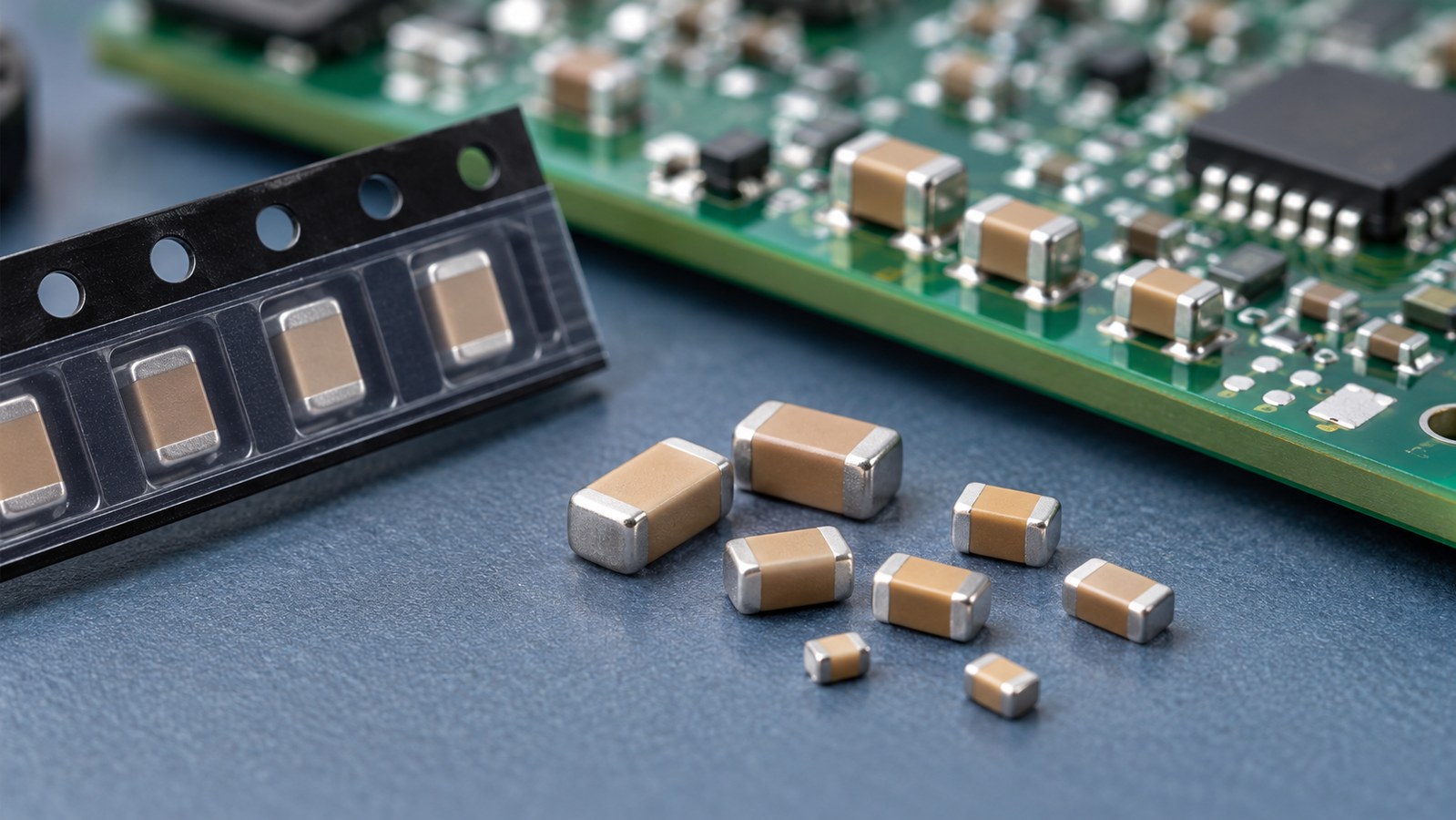
Your preferred multilayer ceramic capacitor (MLCC) is unavailable, and a supplier offers another part with the same capacitance, voltage rating, dielectric, and package size. The purchasing description matches. Can you release the replacement to production?
For many ceramic capacitors, that description is only the first screening step. The capacitance available in the powered circuit can differ from the nominal value on the BOM. Before approving an alternate, buyers and engineers need to compare effective capacitance under the intended operating conditions and confirm that the circuit still meets its requirements.
What DC bias means for an MLCC replacement
DC bias is the change in capacitance caused by an applied DC voltage. High dielectric constant ceramic capacitors, including common X5R and X7R types, can lose capacitance as the applied voltage rises. Murata explains this behavior in its ceramic capacitor DC-bias guidance. Temperature-compensating types such as C0G do not exhibit the same DC-bias characteristic.
This distinction matters when a purchasing team sees two parts described as “10 µF.” That number identifies nominal capacitance under specified measurement conditions. It does not establish the capacitance that either part will provide at the voltage used on your board.
Treat matching BOM descriptions as a shortlist, then ask engineering to evaluate the exact manufacturer part numbers. A supplier cross-reference is a proposed candidate; the approval belongs to the team responsible for the design.
Start with the circuit requirement
Before comparing candidates, write down what the capacitor must do. Is it an output capacitor for a regulator, local supply decoupling, or part of a filter? The approval criteria should come from that function and the relevant device documentation.
For example, a regulator may specify an acceptable output-capacitance range and conditions for stability. Copy those requirements from the exact regulator datasheet and revision used by the project. Do not transfer a requirement from a similar device or assume that more capacitance is always acceptable.
Record the DC voltage across the capacitor, its expected temperature range, and any relevant ripple or transient conditions. Use the capacitor's actual location in the circuit: an input capacitor and an output capacitor may experience different voltages even when they sit beside the same regulator.
Buyers do not need to perform the electrical analysis themselves. They do need a clear request that tells the supplier which characteristics engineering must verify.
Compare exact parts at the same operating point
1. Collect the manufacturer data
Obtain the datasheet and available DC-bias curves for both the original part and the proposed replacement. Use the complete ordering code, including suffixes that identify the product variant or packaging. Save the document revision or retrieval date with the comparison.
Manufacturer tools can help where a short datasheet omits application curves. Murata's SimSurfing MLCC tool, for example, provides DC-bias, temperature, and frequency characteristics. Use the relevant manufacturer's data for each candidate rather than applying one brand's curve to another brand's part.
2. Read the graph carefully
Check whether the vertical axis shows capacitance directly or percentage change from a reference value. A graph showing a 40% decrease is different from a graph showing 40% retained capacitance. Note the test temperature, AC measurement level, and frequency before comparing two curves.
Read both parts at the voltage the capacitor will experience. Comparing one candidate at 3.3 V and another at 5 V does not answer whether they are equivalent on the same rail. Keep screenshots or exported data so a later reviewer can reproduce the comparison.
3. Separate typical behavior from an acceptance limit
Check whether the curve is identified as typical, a simulation, or a guaranteed limit. If the documentation does not establish a minimum under your conditions, ask the manufacturer for clarification. A useful selection graph is not automatically a production acceptance specification.
Temperature and manufacturing tolerance also affect the capacitance available in an application. Texas Instruments discusses these factors in LDO Basics: Capacitor vs. Capacitance. Build the assessment from the candidate's documentation and avoid counting a reduction twice if combined-condition data already includes it.
A screening example: two nominally identical capacitors
Consider a hypothetical 5 V rail with an engineering requirement for at least 4.7 µF effective capacitance. Two proposed capacitors are each described as 10 µF. Assume, solely for this example, that their typical DC-bias data at the selected conditions shows 6.0 µF for Candidate A and 4.0 µF for Candidate B.
Candidate B already falls below the assumed requirement. Candidate A passes this initial comparison, but the review is incomplete. If engineering applies a separate 10% negative-tolerance allowance to the biased value for this simplified screen, Candidate A becomes 5.4 µF and Candidate B becomes 3.6 µF.
These are illustrative arithmetic values, not specifications or test results for real components. The calculation does not include temperature, aging, or other application effects. It shows why two matching nominal values can lead to different sourcing decisions; final qualification needs documented limits and circuit validation.
Why a higher voltage rating is not enough
When an alternate has a higher voltage rating, it is tempting to assume it will retain more capacitance. That assumption needs checking. Infineon's MLCC DC-bias guidance notes that a higher rated voltage does not necessarily improve DC-bias behavior.
The practical decision is to compare the actual curves. If engineering considers a larger package or a different nominal capacitance, include the physical and assembly consequences in the review: land pattern, component height, placement clearance, and any required board change.
A candidate that requires a footprint change may still be useful for a future revision, while being unsuitable for the current production build. Make that distinction explicit before the buyer places an order.
Validate the circuit before releasing the alternate
Capacitance is one part of the approval. Check the required dielectric, dimensions, termination, qualification grade, assembly requirements, and relevant electrical characteristics. Record every difference rather than treating an apparent upgrade as an automatic match.
For regulator output capacitors, equivalent series resistance (ESR) can also matter. TI's application report on ESR and LDO stability distinguishes older regulators with specific ESR needs from devices designed for ceramic capacitors. The acceptable conditions depend on the regulator; lower ESR is not a universal substitution rule.
Agree on validation before ordering production quantities. Depending on the circuit, the plan may include startup, load-transient response, ripple, and operation across specified voltage and temperature conditions. Define pass/fail criteria, test the candidate on the intended board, and retain the results with the approval.
A successful nominal-condition check should not silently become approval for every operating corner or every product using a similar BOM line.
A practical buyer–engineer release checklist
- Identify the original and proposed manufacturer part numbers in full.
- Record the capacitor's function, operating voltage, temperature range, and circuit acceptance criteria.
- Compare DC-bias data at consistent conditions and identify whether it is typical or guaranteed.
- Document tolerance and other required allowances, with unresolved questions assigned to an owner.
- Confirm physical fit, assembly compatibility, qualification requirements, and the validation outcome.
- Record engineering approval, affected BOM revisions, and any restrictions on where the alternate may be used.
Keep approval status visible in the procurement record. “Suggested,” “under evaluation,” and “approved” should be separate states. This prevents an urgent quote from being mistaken for permission to substitute material.
Make the sourcing request specific
Cplus Electronics lists alternative-passive sourcing services, including ceramic capacitors. When seeking a candidate, share the original part number, quantities, required delivery date, and the technical criteria from engineering. State whether you need an already approved alternate or a proposal for evaluation.
You can submit your component requirement to Cplus Electronics with those details. Keep commercial availability and technical approval as separate decisions: the useful replacement is the exact part your team has documented and validated for the intended application.