
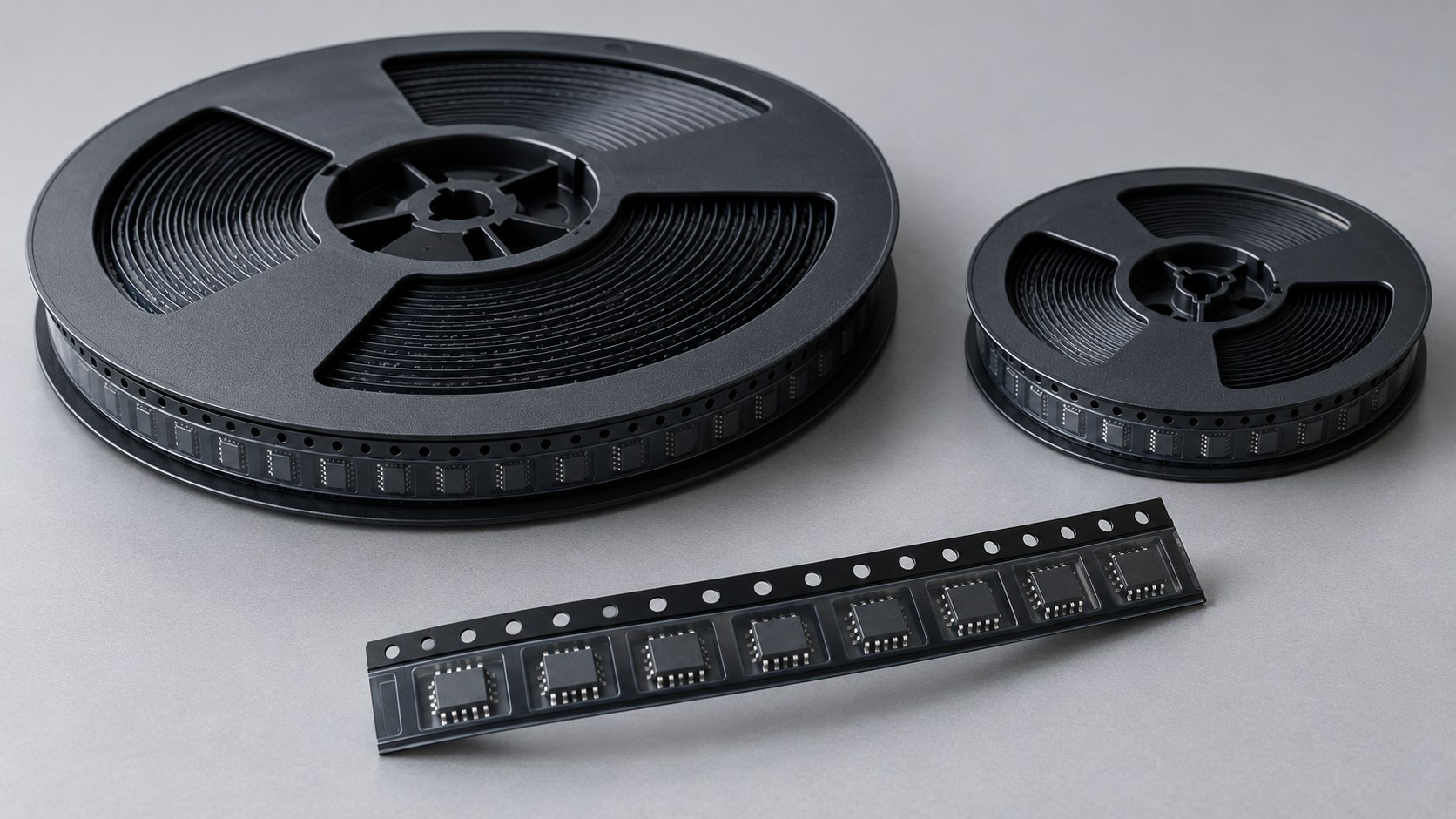
A supplier confirms the correct part number and quantity. Receiving checks the shipment against the purchase order. Then the assembler finds several short tape strips where the production plan expected one continuous reel. The parts may meet the electrical requirement, but the kit still needs additional preparation.
For OEM buyers and contract manufacturers, the practical question behind cut tape vs tape and reel is whether the supplied format matches the intended assembly process. Set that requirement before requesting quotations. A useful RFQ defines the component, the usable quantity, and the packaging the assembler has agreed to accept.
Cut tape vs tape and reel: compare three supply formats
Cut tape is a length of populated carrier tape cut from a reel. A full reel supplies the manufacturer's standard reel quantity. A custom reel typically takes a smaller requested quantity and prepares it on a reel with loading sections. Confirm the supplier's exact service definition: a reel-shaped container alone does not establish continuity, loading suitability, or traceability.
| Supply format | When to consider it | What to confirm |
|---|---|---|
| Cut tape | Samples or small builds where the assembler accepts strips. | Number of strips, minimum strip length, loading method, and preparation allowance. |
| Manufacturer full reel | Builds or planned releases that justify the standard quantity. | Exact orderable part number, reel quantity, carrier dimensions, and remaining-inventory plan. |
| Custom reel | A smaller build that needs reel feeding without buying a full standard reel. | Continuous populated section, leader and trailer, approved splices, reel dimensions, fees, and labeling. |
For example, Texas Instruments' carrier-packaging guidance says its cut-tape orders may use multiple strips. Its custom-reel service uses a continuous section from one reel, with added leader and trailer. Those are TI's stated arrangements; obtain equivalent written details from the supplier handling your order.
Separate the device package from its shipping carrier
Terms such as SOIC describe the physical IC package. Tube, tray, and tape-and-reel describe how devices are supplied. Recording only the footprint or package type leaves the shipping arrangement unresolved.
Consider the SI82393CD-AS gate-driver listing, which identifies tube packaging. Skyworks' Si8239x datasheet, revision A, ordering guide identifies this device as SOIC-16 wide body and states that a terminal R denotes the tape-and-reel option within this family. The distinction matters when the assembly plan expects tape feeding.
Do not add or remove a suffix by habit, or assume that another manufacturer's R means the same thing. Ask engineering to approve the exact orderable number and ask manufacturing to approve the carrier. If tube-supplied devices are proposed, establish whether the assembler can use the tubes directly or requires an approved packaging conversion. The catalog listing does not establish current stock or the availability of another packing option.
Get the assembler's packaging acceptance before quoting
Send the proposed format to the team that will actually load the parts. Ask for its current kitting requirements and record the applicable document revision with the build. “Suitable for SMT” is too broad to serve as an acceptance condition.
- Continuity: Is one continuous populated section required, or are several strips acceptable? Define the permitted number and minimum length.
- Feeder fit: Confirm carrier width, component pocket pitch, reel diameter, and any equipment-specific restrictions.
- Loading sections: Specify the required carrier-tape and cover-tape leader and trailer arrangement.
- Splices: Establish whether splices are allowed and which joining method the line accepts.
- Orientation: Reference the manufacturer's packing drawing and the assembler's loading convention, especially for polarized devices.
- Identification: Agree how each reel or strip will retain its part number, quantity, lot/date-code information, and internal BOM reference.
Use the relevant manufacturer's packaging data rather than copying dimensions from an unrelated component. Johanson Technology's packaging guide, for instance, provides different reel quantities and carrier details for different product types and includes leader/trailer and peel-force information. A dimension shown for one family is not a universal receiving limit.
Count the pieces the build needs, including agreed losses
The BOM consumption quantity and the purchase quantity may differ. Ask the assembler to identify allowances for loading, setup, handling losses, and any separately planned rework reserve. Keep these quantities visible rather than burying them in a rounded order total.
Assembly providers set their own rules. Bay Area Circuits' kitting guidelines specify different extra quantities by component type and size, alongside tape-continuity requirements. These illustrate why a blanket allowance is unreliable; apply the requirements agreed with your own assembler.
Hypothetical example: A build of 240 boards uses two identical SMD ICs per board, giving 480 placements. Assume the assembler approves 24 additional devices for this job. The purchase requirement is then 504 devices. The 24-piece allowance is an example, not a recommended percentage.
Suppose the available standard reel contains 1,000 devices. Compare three proposals: 504 devices on several cut strips, a custom reel containing 504 devices, or a 1,000-piece manufacturer reel. The cut strips need explicit acceptance. The custom reel needs its preparation conditions confirmed. The full reel leaves 496 devices to identify, store, and allocate to future demand.
Choose after confirming both manufacturing acceptance and the plan for any remainder. A custom reel can be useful for a small automated build, but it is not automatically necessary when the assembler already accepts cut tape.
Turn the agreement into an RFQ line suppliers can answer
Keep the approved manufacturer part number separate from the requested supply format in your spreadsheet. Add fields for populated quantity, number of carriers, continuity, preparation requirements, traceability, and packaging exceptions. This lets suppliers explain their actual offer without silently changing the technical requirement.
For the hypothetical build, an accompanying instruction could read:
Supply 504 devices of the approved orderable part number on one custom reel with one continuous populated section. Leader, trailer, reel dimensions, orientation, and splice method must meet the attached assembler-approved packaging specification. Preserve original manufacturer identification and provide a documented link to any replacement label. State packaging charges and preparation time separately. Quote any exception for review before order acceptance.
Attach the actual agreed specification when using wording like this. Ask the supplier to acknowledge each requirement or describe the deviation. For cut tape, replace the custom-reel instruction with the approved strip count and minimum length; do not leave “cut tape acceptable” undefined.
Require an explicit response when the offered quantity is assembled from multiple lots or carriers. A single reel does not, by itself, prove a single manufacturing lot. For broader source and supplier checks, refer to the existing electronic component sourcing guide.
Check the delivered kit against the agreed format
Before release to production, reconcile the orderable number, quantity, carrier count, labels, and any approved exceptions. Review accessible tape condition and packaging documentation under the site's handling procedure. Route discrepancies to quality and manufacturing before the scheduled build rather than leaving the operator to improvise.
Keep ESD and moisture protection in the packaging agreement as well. Rewinding devices onto a reel is a carrier operation; the required protective packing and handling still need to be specified and maintained. Avoid opening protective packaging simply to count or photograph parts without an approved procedure.
Cplus Electronics lists tape-and-reel work among its value-added services. When requesting support, provide the exact device, quantity, assembler-approved packaging requirements, and delivery target. Confirm feasibility, documentation, charges, and timing for that specific job.
You can include those details with a component or BOM quotation request. The objective is a shipment the assembler can accept as planned, with any preparation work and exceptions resolved before the parts arrive.