When an electronic component quote lists a minimum order quantity (MOQ) and an order multiple, find the smallest quantity the supplier will accept that covers your build. Then price that quantity and the next eligible price break. Compare the total amount payable, how many parts you can actually use, and what would happen to the surplus if the follow-on build slipped. Run the calculation for each quote using its own quantity rules.
Electronic component MOQ vs. order multiple and standard pack
Start by converting each quote to individual pieces. A line for five packs of 200 parts represents 1,000 pieces. A price of $120 per pack represents $0.60 per piece. Keep the purchase order unit explicit, especially if your ERP stores the BOM requirement in pieces and the supplier invoices by pack.
- Minimum order quantity (MOQ) is the smallest quantity the supplier will accept for the quoted line or buying option.
- Order multiple defines the allowed quantity increments. Ask for the first three valid quantities if the quote does not say whether increments start from zero or from the stated minimum.
- Standard pack quantity (SPQ) is the number of pieces in the supplier’s standard pack for that item. Ask whether full packs are mandatory for the offer and whether smaller quantities are available under a separate quote.
- Price break is the threshold for a different unit price. Confirm which quantity qualifies and whether that rate applies to every piece on the order.
Real ordering systems keep these fields separate. Analog Devices’ ordering FAQ treats the order multiple as an additional rule when ordering above the MOQ. Texas Instruments’ inventory and pricing documentation exposes its store MOQ, standard pack quantity, and quantity price breaks as separate fields. Use the values on the specific supplier offer and ask the seller to expand abbreviations such as MPQ if the quote leaves their meaning unclear.
Calculate the smallest quantity the supplier will accept
Use net demand for the dated build. Include any approved assembly allowance, then subtract usable inventory already assigned to that build and confirmed incoming stock that can clear receiving in time. Leave forecast demand as a separate quantity so the team can see how much extra material a price break would commit.
- Take the higher of the net requirement and the quoted MOQ.
- Round that quantity up to the next allowed order quantity. If the supplier accepts only whole multiples of 200 from zero and the higher figure is 640, the smallest valid quantity is 800.
- Check whether the next price-break threshold is itself orderable. If the threshold is 900 and valid orders are 800, 1,000, and 1,200, ask for pricing at 1,000. Apply the same logic to any pack-only rule or maximum quantity the supplier quotes.
Get the rounded quantity confirmed before releasing the PO. For example, with a minimum of 150 and an increment of 100, an offer that starts at 150 may permit 150, 250, and 350. An offer that requires whole multiples of 100 and uses 150 as a lower bound may start at 200. A list of valid quantities resolves the difference before the supplier acknowledges a higher buy than planned.
Compare the full spend at each orderable quantity
Multiply the actual purchasable quantity by the rate for that order and add the charges that change with the option, such as split-pack fees, freight, or required incoming inspection. Use the same currency and delivery basis for every offer. Confirm that each quantity is available by the required date in packaging your assembler accepts. If a quote earns its rate only on an aggregate order or on a minimum release, ask the supplier to show how each delivery will be invoiced.
Worked example for a 640-piece requirement
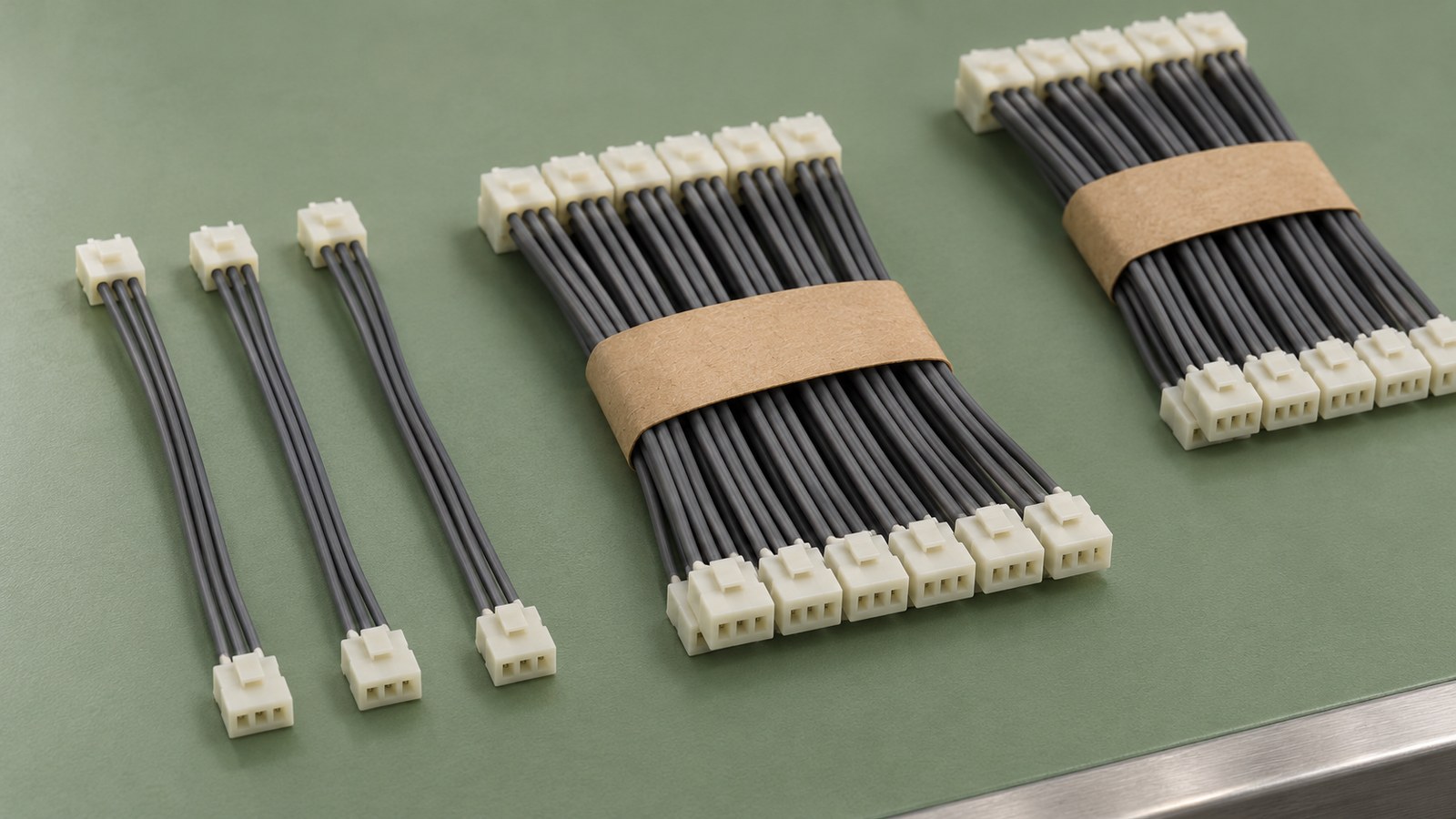
In this hypothetical example, a contract manufacturer needs 640 short cable assemblies for a released build. Both suppliers quote the approved part and can meet the required delivery date. Supplier A requires a minimum of 600 and sells in multiples of 200. Supplier B requires a minimum of 100 and sells in multiples of 10. Each row includes a hypothetical delivery charge. The quoted rates apply to every piece at the stated quantities.
| Quote option | Pieces ordered | Unit price | Delivery | Total spend | Pieces above demand |
|---|---|---|---|---|---|
| Supplier A, smallest valid order | 800 | $3.05 | $40 | $2,480 | 160 |
| Supplier A, price break | 1,000 | $2.35 | $40 | $2,390 | 360 |
| Supplier B, exact requirement | 640 | $3.55 | $45 | $2,317 | 0 |
Buying 1,000 from Supplier A costs $90 less than buying 800 from the same supplier. Supplier B still covers the released build for $73 less than the 1,000-piece order and leaves no surplus. If purchasing has no approved use for the extra 360 pieces, the exact-quantity offer has the lowest immediate spend, with no additional material to store.
Now suppose a second released build needs 180 pieces and those assemblies can use the same approved part and revision. If Supplier B confirms a separate 180-piece order at $3.55 per piece plus another $45 delivery charge, the two orders would total $3,001. Buying 1,000 up front would cover both builds for $2,390 before any carrying or handling costs and leave 180 pieces. The $611 difference is the amount available to absorb those costs before the two options tie. Keep the unassigned 180 visible in the approval so the team can decide who owns and stores them.
Ask for two quantities on the same RFQ line
Give suppliers your firm net quantity and ask for the smallest order they can accept for the approved part, followed by the next orderable price tier. If you can use a split pack, request it as a separate option with its fee and packaging condition stated. If you need scheduled deliveries, ask for the quantity, price, and minimum release for each shipment, plus the total quantity you would commit to on the PO.
Before awarding the line, record the quoted unit of measure, ordered pieces, extended spend, receiving date, and disposition of any surplus. For a contract build, confirm who pays for and owns extra stock. If a second build justifies the discount, verify the exact part or approved revision, the date the stock will be consumed, and any requirements that could prevent reuse. Apply the same checks across high-spend lines as part of a broader BOM cost-reduction review.
If a supplier’s minimum leaves a gap between what you need and what you can buy, send the part requirement to C Plus Electronics. The form takes part numbers and quantities for one or more lines and has an option to attach a shortage list. Include the full manufacturer part number, firm quantity, need date, approved packaging or alternates, and documentation requirements in your list. Ask for the smallest orderable quantity and the next applicable price break so you can compare both before issuing a purchase order.